

Four years ago, I sat across from the managing partner of a mid-sized advisory firm who was convinced his growth had stalled because of insufficient lead flow.
His seminar campaigns were underperforming. Cost per registrant was climbing. Attendance was inconsistent. His solution? Increase ad spend.
When we traced the numbers deeper, something else emerged.
They were getting inquiries. The problem was conversion quality.
Their messaging was identical to every other firm in the market. “Comprehensive planning.” “Holistic advice.” “Client-first fiduciaries.” There was nothing that answered why someone should choose them over the advisor across town.
We were trying to optimize a funnel built on generic positioning.
That was the moment it became clear to me that most firms do not have a lead problem. They have a differentiation problem.
And no amount of ad spend fixes that.
What Generic Positioning Actually Sounds Like
When I reviewed that firm’s website and seminar invitations, the language looked like this:
“Comprehensive financial planning tailored to your unique goals.”
“Client-focused service built on trust and integrity.”
“Helping you pursue financial independence.”
“Holistic retirement strategies designed around you.”
“Fiduciary advice with your best interests at heart.”
None of those statements are wrong.
They are just universal.
Every advisory firm claims comprehensive planning. Every firm says they are client-focused. Every firm emphasizes trust and fiduciary responsibility.
That is not positioning. That is compliance-level language.
When I asked, “Who specifically are you built for?” the answer was, “Pre-retirees and retirees.”
That describes half the population in their county.
There was no clear niche, no defined problem they solved better than anyone else, no market they owned.
The messaging was safe. Generic. Interchangeable.
And when you are interchangeable, the only differentiator left is price or proximity.
The Three Questions That Reveal the Real Problem
When an RIA owner insists they need more leads, I do not debate them.
I ask three questions:
First, how many inquiries did you receive in the last 12 months?
Second, how many initial consultations did that turn into?
Third, how many of those became funded households, and what was the average assets per relationship?
Then we calculate cost per funded client.
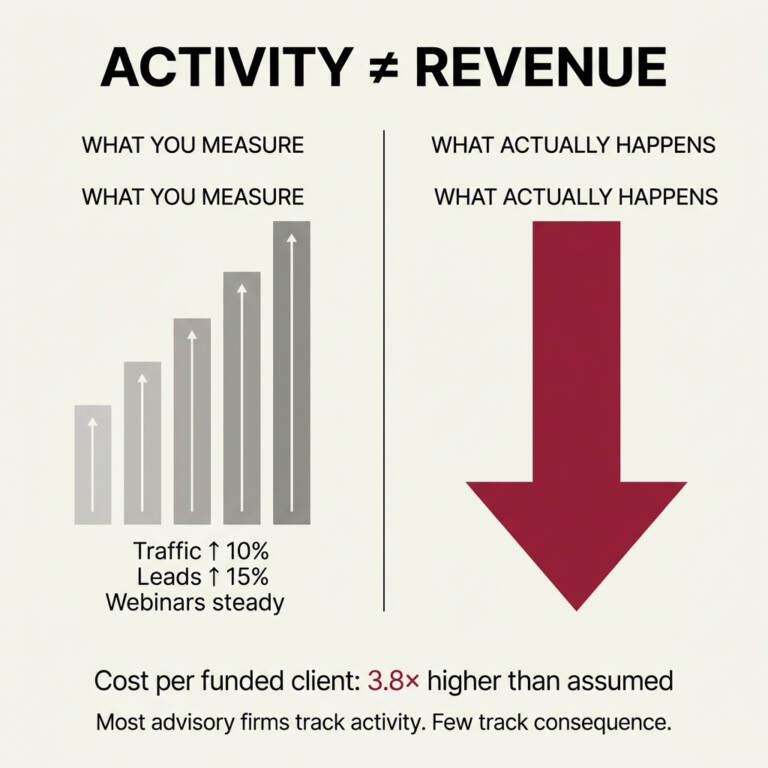
Almost every time, the issue is not zero activity.
It is that conversion from inquiry to qualified household is weak, and average assets per new client is lower than it should be.
Then I ask a harder question:
If a highly qualified prospect lands on your website today, is there a clear reason they should choose you over the advisor across town?
Silence usually answers that.
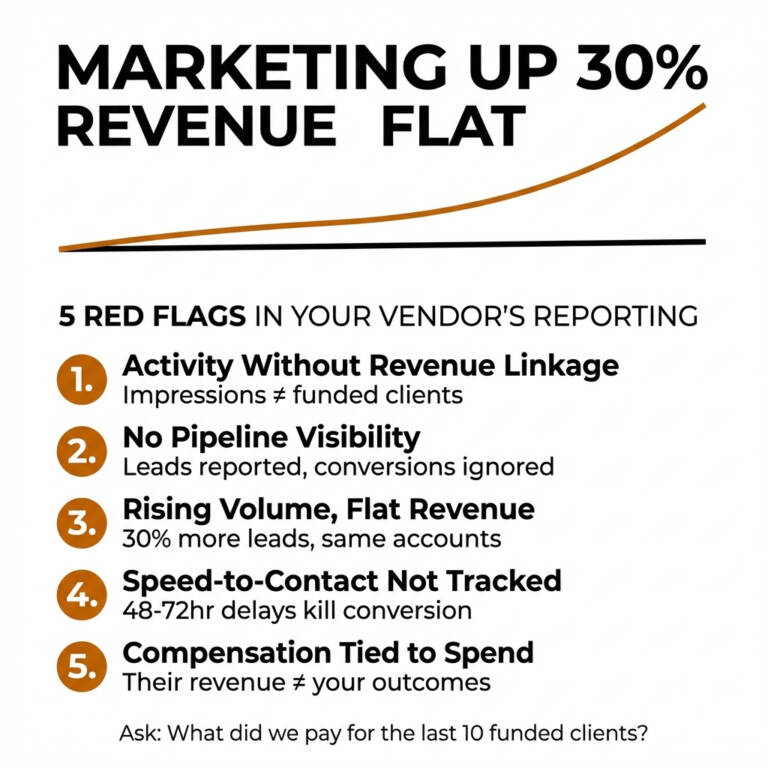
More leads into a generic message just produces more unqualified conversations.
Better positioning improves who raises their hand in the first place.
When the right people see themselves in your messaging, lead quality improves, closing ratios improve, and revenue per client improves.
The problem is not volume. It is alignment.
Research backs this up. Only 27% of RIA firms have marketing plans—a 41% decline from just 12 months prior. This strategic gap costs firms millions in unrealized growth potential.
Meanwhile, advisors with defined marketing approaches get 168% more leads from their websites than advisors without clear strategy.
The difference is not spending more. It is strategic clarity driving results.
What Happens When You Narrow Positioning
One firm I worked with was positioning themselves as a retirement planning firm for “individuals and families preparing for retirement.”
Broad. Safe. Interchangeable.
Their seminars were drawing attendees, but many were fee-sensitive, early accumulators, or simply information seekers. The advisors were spending time in meetings that rarely converted into meaningful relationships.
We narrowed the positioning.
Instead of serving “pre-retirees,” we focused specifically on business owners within five years of an exit who needed coordinated tax, liquidity, and retirement planning around a sale event.
That changed everything.
The messaging shifted from generic retirement language to very specific problems:
-
How to structure a business sale to reduce tax drag
-
How to replace business income with portfolio income
-
How to design a post-sale distribution strategy
The seminars became smaller.
But the conversations were different.
Attendees came in with a triggering event. Average assets per new client increased. Closing ratios improved because the firm was speaking directly to a defined pain point.
They did not increase ad spend. They did not overhaul their tech stack.
They clarified who they were built for.
Lead volume dipped slightly. Lead quality improved materially.
That is the trade most serious advisory firms should be willing to make.
The data supports this approach. According to research from Kitces.com, niche firms experience a 58% average client growth rate compared to 26% for non-niche firms.
Advisors who pick a niche earn an average of 12% more than generalists. More striking, 70% of top financial advisors experienced a tremendous increase in income after choosing to specialize.
The Fear of Saying No
When I worked with that firm to narrow their focus to business owners within five years of exit, their first reaction was predictable.
“If we narrow this much, we are going to shrink our pipeline.”
There is a real fear of turning away revenue.
Advisors build their firms by saying yes. So the idea of intentionally excluding people feels risky.
I did not try to convince them with theory.
I showed them their own data.
We looked at the last 24 months of new clients and asked:
-
Where did the largest relationships come from?
-
Which clients were easiest to close?
-
Which ones generated the most referrals?
There was a pattern.
The highest value, lowest friction relationships were almost all tied to liquidity events or business transitions.
They were already strong in that lane. They just were not claiming it.
Then I reframed the issue.
Narrowing positioning does not mean rejecting everyone else. It means leading with a clear specialty.
You can still serve others. But your marketing should speak directly to the segment where you win most consistently.
Once they saw that they were not shrinking opportunity, but concentrating firepower where they already had momentum, the fear eased.
Specificity does not reduce opportunity. It increases relevance.
And relevance is what improves lead quality.
Why Technology Cannot Fix Weak Positioning
Most RIA owners are being sold CRMs, marketing automation platforms, and AI tools as the solution to their growth problems.
What I typically see is amplification of mediocrity.
When positioning is weak and a firm installs a new CRM, marketing automation platform, or AI content tool, it does not fix the underlying issue. It simply accelerates the same generic message to a larger audience.
Now instead of inconsistent outreach, they have automated generic outreach.
Instead of one bland seminar invitation, they have a twelve-email nurture sequence that says nothing distinctive.
The technology works exactly as designed.
It just distributes an undifferentiated story.
Then frustration sets in.
They say, “We invested in the platform. Why are we not seeing growth?”
The problem is not the CRM. It is not the automation. It is not the AI.
Those tools are multipliers.
If your positioning is clear and specific, technology scales it efficiently.
If your positioning is vague, technology scales confusion.
I have seen firms spend tens of thousands on systems, only to realize later that their core message still sounds like every other advisory firm in their market.
Technology should come after clarity.
Otherwise you are just building a faster engine for the wrong vehicle.
Problems Worth Owning
Most advisors default to age-based positioning.
“Pre-retirees.” “Retirees.” “High-net-worth families.”
Those are categories. Not problems.
The real opportunity is in repeatable, high-stakes financial events:
-
Business owners preparing for a liquidity event within five years
-
Corporate executives managing concentrated stock positions
-
Physicians transitioning from hospital employment to private practice
-
Divorcees over 50 navigating asset division and retirement impact
-
Recently widowed spouses who suddenly become the primary financial decision-maker
These situations feel narrow.
But they are financially complex, emotionally charged, and time-sensitive.
When someone is facing one of those events, they are not browsing for “comprehensive planning.”
They are searching for someone who understands their exact situation.
Advisors overlook these because they fear shrinking the audience.
In reality, they are sharpening relevance.
And when relevance increases, so does urgency, conversion rate, and average assets per relationship.
The opportunity is not in serving everyone who is aging.
It is in owning a specific transition where the stakes are high and the need for guidance is immediate.
What to Do Monday Morning
If you are reading this and realize you have a positioning problem, not a lead problem, here is what to do Monday morning.
Block two hours and do one exercise.
Open your website homepage.
Then answer this question honestly:
If I removed my firm’s name and logo, could this site belong to five other advisors in my city?
If the answer is yes, you have a positioning problem.
Next, review your last ten new clients.
Look for patterns:
-
What specific event triggered them to reach out?
-
What was happening in their financial life?
-
Which ones moved fastest?
-
Which ones brought the most assets?
You are not looking for demographics.
You are looking for a repeatable problem you solve better than most.
Then rewrite your homepage headline to reflect that specific problem.
Not “Comprehensive Financial Planning.”
But something that speaks directly to the event or situation you are uniquely built to handle.
That is it.
No new software. No ad campaign. No technology overhaul.
Clarity first.
When your message reflects the problems your best clients are actually experiencing, lead quality begins to change before your marketing spend does.
I have spent over 25 years working with banks, consulting companies, and advisory firms. I started Rokture to help organizations develop sustainable digital strategies without massive investments in technology, advertising, or marketing.
If you are an independent RIA owner between $50M and $300M AUM and you are frustrated with inconsistent digital lead flow, the issue may not be your lead generation tactics.
It may be that your positioning is not clear enough for the right people to recognize themselves in your message.
Fix that first.
Everything else gets easier.