
I have watched advisory firms celebrate marketing dashboards while their client acquisition economics quietly collapse.
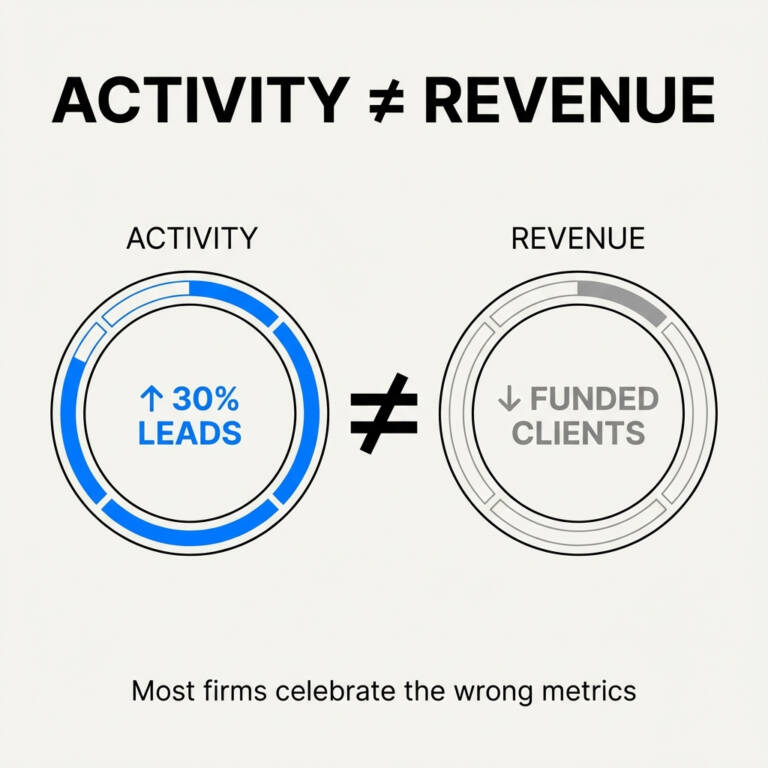
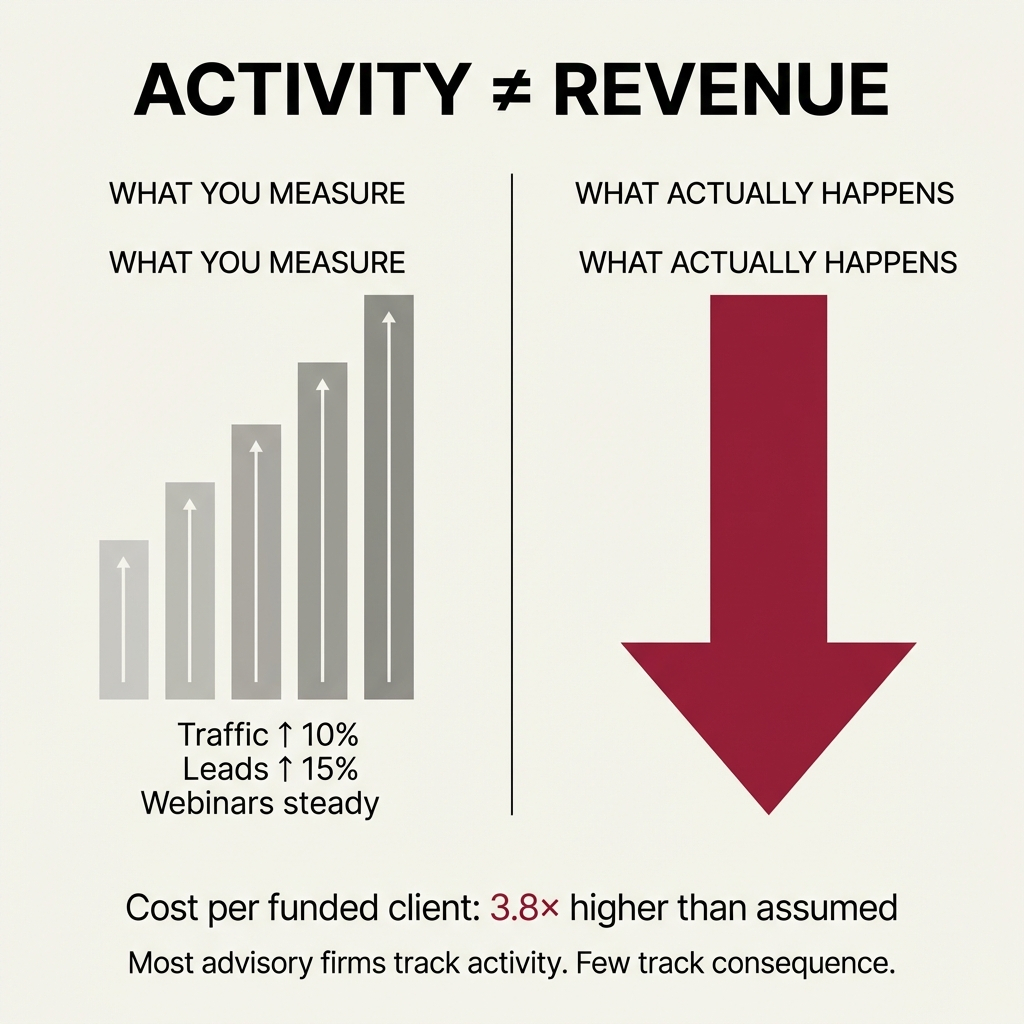
Traffic up 10 percent year over year. Lead volume increasing. Webinar registrations steady. The marketing team reports growth across impressions, clicks, and form submissions.
Leadership believes the digital engine is working because activity metrics trend upward.
Then we trace the numbers into funded clients.
Cost per lead looks reasonable. Cost per consultation runs higher than expected. Cost per funded client sits materially higher than anyone assumed.
In one case, only a small fraction of qualified inquiries actually converted into funded accounts. No one tracked speed-to-contact. No one measured handoff quality between marketing and sales.
The issue was not traffic. It was conversion discipline and revenue attribution.
The dashboard measured activity. It did not measure consequence.
That shift in perspective changed where we focused immediately.
Why Most Advisory Firms Track the Wrong Metrics
The average firm converts 37% of their qualified leads to clients, yet just 38% of firms formally track leads. This blind spot costs advisory firms real revenue.
Most firms operate with a marketing dashboard but no revenue pipeline dashboard.
They measure the top of the funnel. They do not measure economic flow through the funnel.
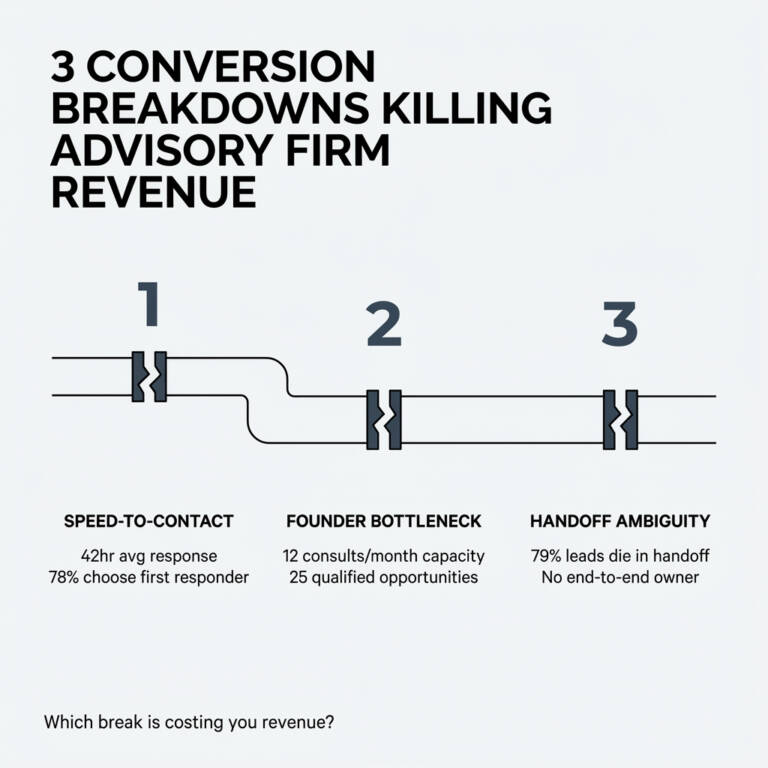
The problem surfaces in three patterns:
First pattern: speed-to-contact failure.
Qualified inquiries sit for 24 to 72 hours before anyone responds. In high-trust financial decisions, momentum is fragile. Delay introduces doubt. By the time contact happens, urgency has cooled or the prospect has spoken to someone else.
Second pattern: founder bottleneck.
The founder insists on handling every meaningful consultation. As demand increases, calendar capacity becomes the constraint. Consultations get delayed, follow-ups stretch, and the pipeline backs up. Growth becomes mathematically capped by founder availability.
Third pattern: handoff ambiguity between marketing and sales.
Marketing reports “qualified lead.” Sales reports “not ready.” No one tracks consultation-to-funded conversion rate by source. Leads die quietly in the gray zone, and the firm blames lead quality instead of pipeline structure.
The unifying issue is not traffic. It is ownership.
When no one owns revenue flow end-to-end, qualified demand dissipates inside the system.
The Revenue-Accountable Metrics Test
My test is simple:
If a metric cannot be traced to funded revenue within a defined time window, it is not revenue-accountable.
Activity metrics describe motion. Revenue-accountable metrics describe economic consequence.
Website traffic is not revenue-accountable unless you can show how traffic converts into consultations and then funded clients.
Lead volume is not revenue-accountable unless you know consultation-to-close rate and cost per funded client.
Email open rates are not revenue-accountable unless they correlate with booked meetings that convert to assets under management.
The line I draw is this:
If removing the metric would not impair my ability to forecast funded revenue, it is an activity metric.
Revenue-accountable metrics must answer one of three questions:
-
How many funded clients did we acquire?
-
What did we pay to acquire them?
-
How long did it take to convert them?
If a metric cannot help answer those questions, it does not belong on an executive dashboard.
That is the discipline most advisory firms lack.
The 30-Day Sprint Structure
The purpose of the 30-day sprint is not to track everything. It is to isolate the constraint.
During a sprint, we reduce measurement to a handful of revenue-linked metrics.
Daily tracking:
-
Number of qualified inquiries
-
Speed-to-contact on new inquiries
-
Number of consultations scheduled
-
Number of consultations completed
The daily focus is responsiveness and flow.
Weekly tracking:
-
Consultation-to-proposal rate
-
Proposal-to-funded client rate
-
Cost per qualified inquiry
-
Cost per funded client
-
Founder involvement hours in consultations
The weekly focus is conversion and capacity.
Financial Services firms achieve a 13% MQL to SQL conversion rate and 16% SQL to Closed Won rate on average. These benchmarks matter because your sprint can measure against them daily.
The Review Cadence That Drives Accountability
The review cadence is simple:
Daily: A short internal check on response time and scheduling.
Weekly: A structured 30-minute review with leadership.
We look at:
-
What moved
-
Where flow slowed
-
Where handoffs failed
-
Where founder capacity is constraining growth
If a metric does not tie directly to funded clients, it does not make the sprint dashboard.
The goal is not more reporting. It is faster learning.
By day 30, we know whether the system can convert demand or whether structure needs to change.
This approach mirrors Agile sprint methodology. If you consistently stay above 75% sprint completion and bounce no more than 10-15% sprint by sprint, you have healthy sprint predictability.
How to Isolate Conversion Bottlenecks
Fixing a broken sales pipeline requires analyzing each stage to identify bottlenecks.
A sprint forces you to diagnose and fix these in real-time, not retrospectively.
In the case I mentioned earlier, the breakdown was not lead quality. It was speed and ownership.
Qualified inquiries were coming in, but response time averaged 48 to 72 hours. In a high-trust advisory environment, that delay alone kills momentum.
Second, consultations were often handled only by the founder. When their calendar filled, qualified prospects waited another week or more. There was no delegated conversion structure.
Third, there was no defined handoff from marketing to sales. Marketing reported “qualified lead.” Sales reported “not ready.” No one measured consultation-to-funded conversion rate.
The structural issue was that the firm had a marketing dashboard but no revenue pipeline dashboard.
Pipeline velocity measures how quickly deals move through each stage. Stage conversion rates track the percentage of deals that advance from one stage to the next. These are critical metrics for weekly sprint checkpoints in financial firms.
The Founder Capacity Conversation
I did not frame it as “you are the problem.”
I framed it as capacity math.
We mapped the numbers together:
-
Number of qualified consultations per month
-
Founder availability per week
-
Average time from inquiry to scheduled call
-
Consultation-to-close rate
When we put it on one page, the constraint became visible without me saying it.
If the founder can realistically handle 12 consultations per month and the pipeline is generating 25 qualified opportunities, growth is mathematically capped.
There was no criticism in that conversation.
It was simply: Here is demand. Here is capacity. Here is conversion.
Once the math was clear, the discussion shifted from identity to structure.
The real insight was that growth had become dependent on one calendar.
Revenue accountability means the system can convert demand without relying on founder bandwidth.
That is when delegation and sprint discipline became logical rather than personal.
Using Sprint Findings to Restructure Vendor Relationships
In one case, the agency optimized for lead volume and cost per lead. Their reporting highlighted traffic growth, form fills, and webinar registrations.
From their perspective, performance was improving.
The advisory firm needed funded clients. They needed clarity on cost per acquired household and conversion from consultation to funded account.
The agency’s compensation was tied to campaign activity and lead generation, not to funded outcomes.
So naturally, they optimized for what they were measured on.
Lead volume increased. Consultations increased modestly. Funded accounts did not increase proportionally.
When we mapped the economics, cost per funded client was significantly higher than leadership believed.
The misalignment was not incompetence. It was incentive design.
The firm needed revenue accountability. The vendor was paid for activity.
Once compensation and reporting were restructured around funded-client metrics, behavior changed quickly.
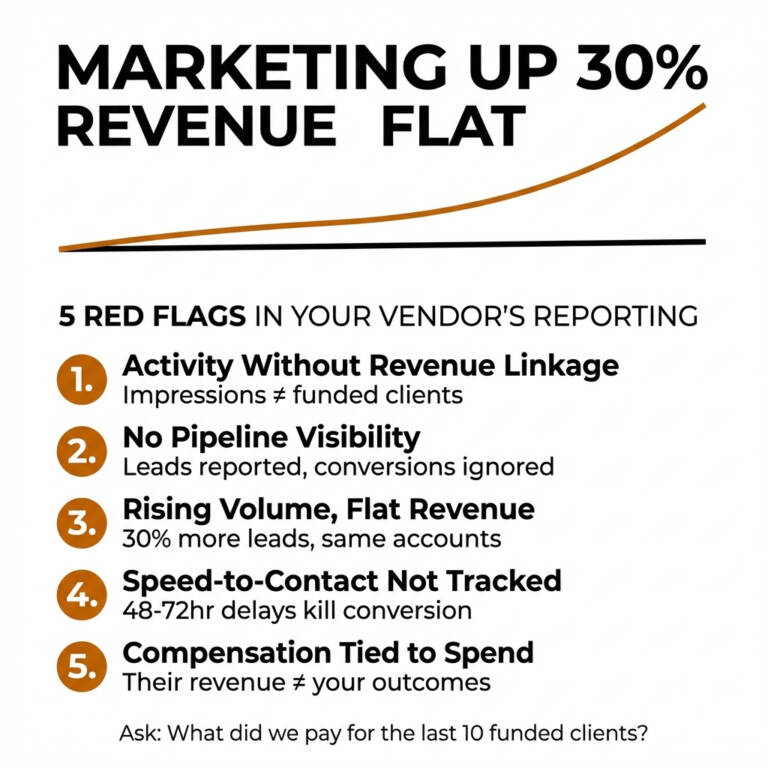
Red Flags in Vendor Reporting
There are specific reporting patterns that immediately signal misalignment:
First red flag: activity without revenue linkage.
If the report leads with impressions, clicks, reach, or engagement and does not clearly show cost per funded client, that is a problem.
Second red flag: no pipeline visibility.
If they report leads but cannot show consultation-to-close conversion rate, they are optimizing top-of-funnel volume, not economic outcomes.
Third red flag: rising lead volume with flat revenue.
If lead counts are up 30 percent but funded accounts are flat, something is broken downstream. If the vendor is still celebrating volume, incentives are misaligned.
Fourth red flag: no discussion of speed-to-contact.
In advisory and specialty financial firms, delay kills conversion. If response time is not tracked, they are not thinking about revenue flow.
Fifth red flag: compensation tied to spend or lead count.
If their revenue increases when your ad spend increases, regardless of funded outcomes, their model is activity-driven.
The executive test is simple:
Ask your vendor, “What did we pay to acquire the last 10 funded clients?”
If they cannot answer clearly, they are optimizing for their business model, not yours.
Why Attribution Is Harder in Specialty Financial Services
Attribution is harder in 1031 exchange and self-directed IRA businesses for structural reasons, not technical ones.
First, the buying cycle is event-driven and irregular. A 1031 exchange client does not wake up casually browsing options. They are triggered by a property sale timeline. The window is compressed, high-stakes, and often influenced by external advisors like CPAs or attorneys.
Second, trust layering is deeper. A prospect might attend a webinar, download a guide, speak to a CPA, receive a referral, and only then contact the exchange provider. Which channel “caused” the funded client? The journey is multi-touch and relationship-driven.
Third, the decision risk is materially higher than most consumer purchases. Moving tax-deferred proceeds or retirement assets creates hesitation. Prospects research quietly. They revisit the site multiple times. They forward content internally. Digital analytics often undercounts the true influence chain.
Fourth, funding does not always happen immediately after consultation. There can be escrow timelines, custodial processing, and compliance reviews. That delay breaks simple attribution models.
In most industries, attribution is about tracking clicks to purchases.
In specialty financial services, attribution is about mapping trust accumulation to funded assets.
If you only measure last-click or lead source, you will misread where influence actually occurred.
Revenue accountability in these firms requires tying marketing activity to funded accounts across time, advisors, and handoffs, not just digital touchpoints.
What Happens After the Sprint
By day 30, the constraint becomes clear.
You know whether the system can convert demand or whether structure needs to change.
You know if the founder is the bottleneck or if handoffs are failing.
You know if your vendor is optimizing for your revenue or their own business model.
You know which metrics actually matter and which ones are noise.
The sprint does not solve everything. It isolates what needs to change.
That clarity is what most advisory firms lack.
They operate on assumptions about what works. The sprint replaces assumptions with evidence.
Once you see the constraint, restructuring becomes logical rather than political.
That is where revenue accountability begins.
How to Start Your Own 30-Day Sprint
You do not need complex software or a massive team.
You need clarity on what you are measuring and why.
Start with these steps:
Week 1: Baseline measurement
Track daily inquiries, speed-to-contact, consultations scheduled, and consultations completed. Establish your current state.
Week 2: Weekly review implementation
Add consultation-to-proposal rate, proposal-to-funded rate, cost per inquiry, cost per funded client, and founder involvement hours. Hold your first 30-minute weekly review.
Week 3: Bottleneck identification
Look at where flow slows. Is it response time? Founder capacity? Handoff quality? Name the constraint.
Week 4: Structural adjustment
Change one thing based on what you learned. Restructure a vendor relationship. Delegate consultations. Fix a handoff process.
By day 30, you will know whether your system can convert demand or whether structure needs to change.
That knowledge is worth more than another quarter of dashboard reports that measure activity instead of consequence.
Revenue accountability starts with knowing where your qualified demand actually goes.
A 30-day sprint shows you exactly that.
If your advisory firm is ready to move from activity metrics to revenue accountability, I can help you design and run your first sprint. Contact me at Rokture to map your conversion flow and isolate the constraints holding back your growth.