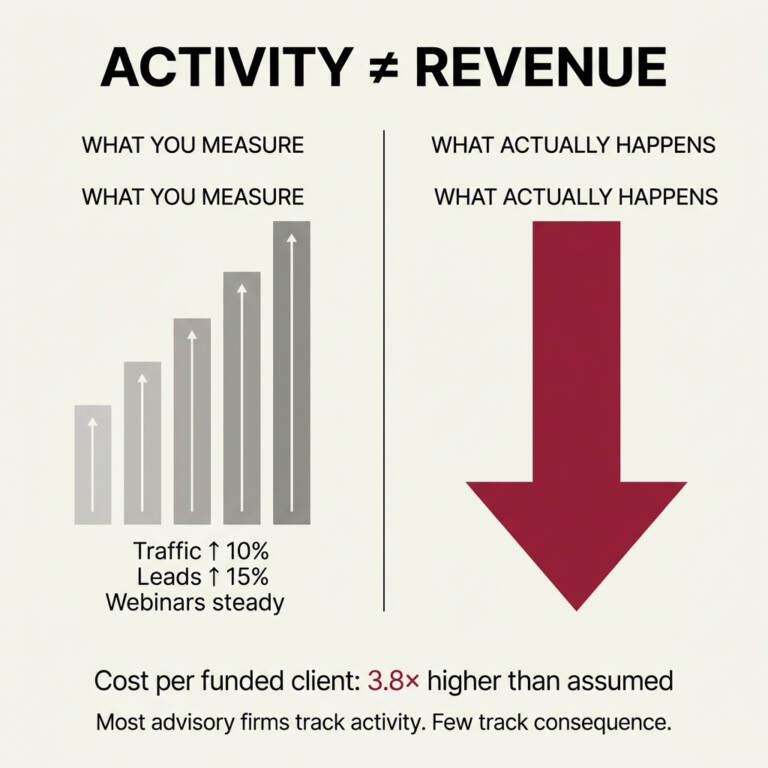

I reviewed a dashboard last quarter with an advisory firm in the 1031 exchange space. Traffic was up 10 percent year over year. Lead volume had increased. Webinar registrations looked steady. The marketing team was celebrating growth across impressions, clicks, and form submissions.
The firm believed their digital engine was working.
When we traced those numbers into funded clients, the picture changed completely.
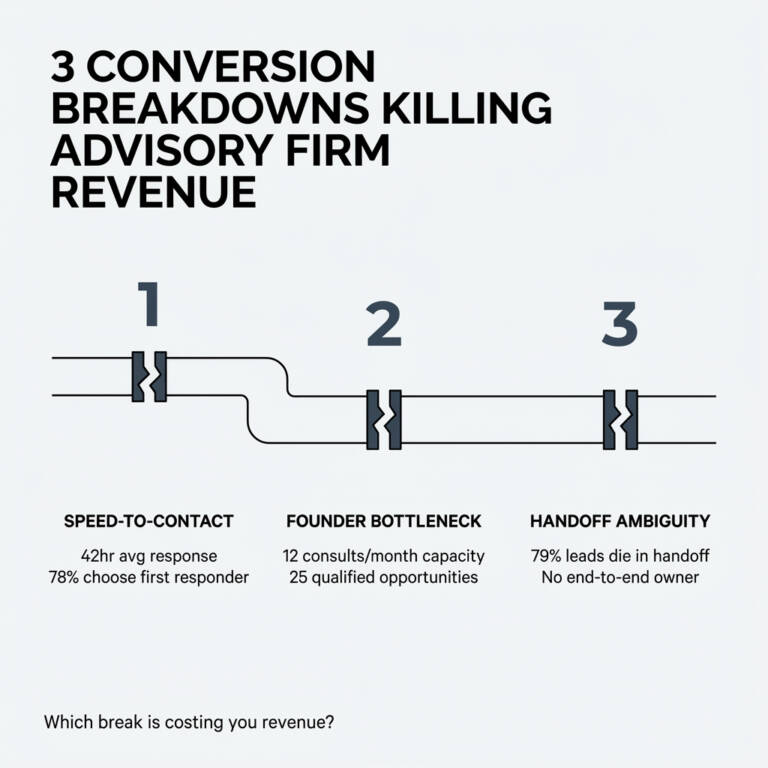
Cost per lead looked reasonable. Cost per consultation was higher than expected. Cost per funded client was materially higher than leadership assumed. Only a small fraction of qualified inquiries actually converted into funded accounts. No one was tracking speed-to-contact or handoff quality between marketing and sales.
The issue was not traffic.
It was conversion discipline and revenue attribution.
The dashboard was measuring activity. It was not measuring consequence.
This is not an isolated case. I have seen this pattern repeatedly across advisory firms, self-directed IRA providers, and specialty financial services companies. Marketing vendors optimize for what they get paid to deliver. If their compensation is tied to lead volume or ad spend, they will deliver exactly that.
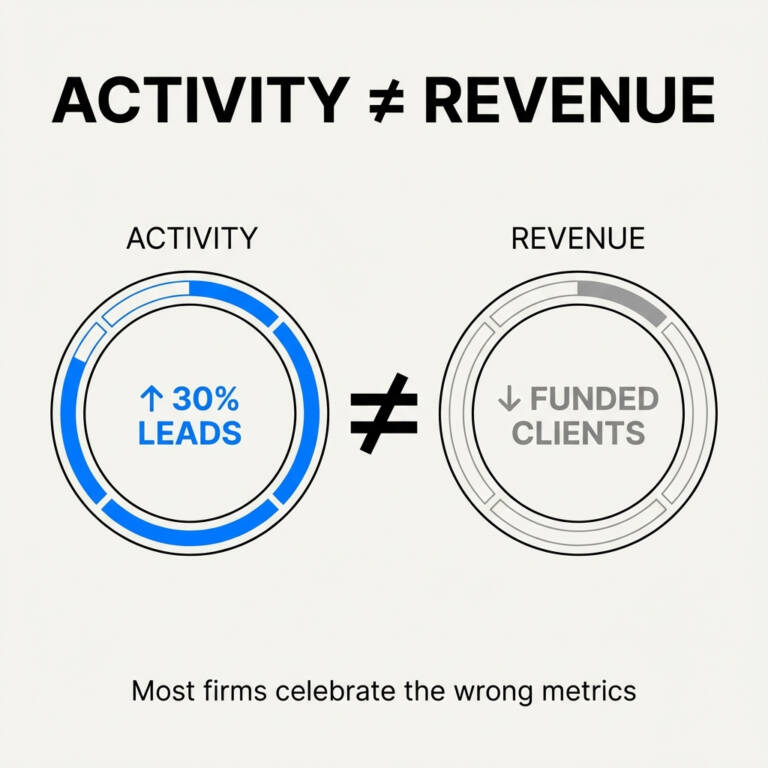
The problem is that lead volume does not equal revenue.
Why Marketing Agencies Serving Specialty Financial Firms Optimize for Activity Instead of Revenue
The structural issue is incentive design.
Marketing agencies are typically compensated in one of three ways: a percentage of ad spend, a flat retainer based on scope, or a fee tied to lead volume. In all three models, their revenue increases when activity increases, regardless of whether your funded accounts increase.
This creates predictable behavior.
They optimize for what gets measured in their reporting: impressions, clicks, cost per lead, webinar registrations, content downloads. These metrics justify their existence. They show motion. They demonstrate effort.
But they do not show economic consequence.
According to research from Martal Group, companies without tight alignment between sales and marketing lose an estimated $1 trillion per year due to poor coordination. When marketing is rewarded for volume and sales is rewarded for revenue, collaboration becomes optional rather than essential.
The result is predictable.
Marketing optimizes for lead generation. Sales complains about lead quality. No one tracks consultation-to-funded conversion rate. Qualified demand dissipates inside the system. The firm blames lead quality instead of pipeline structure.
The vendor is not incompetent. The incentive design is misaligned.
The Red Flags in Your Marketing Vendor’s Monthly Reporting
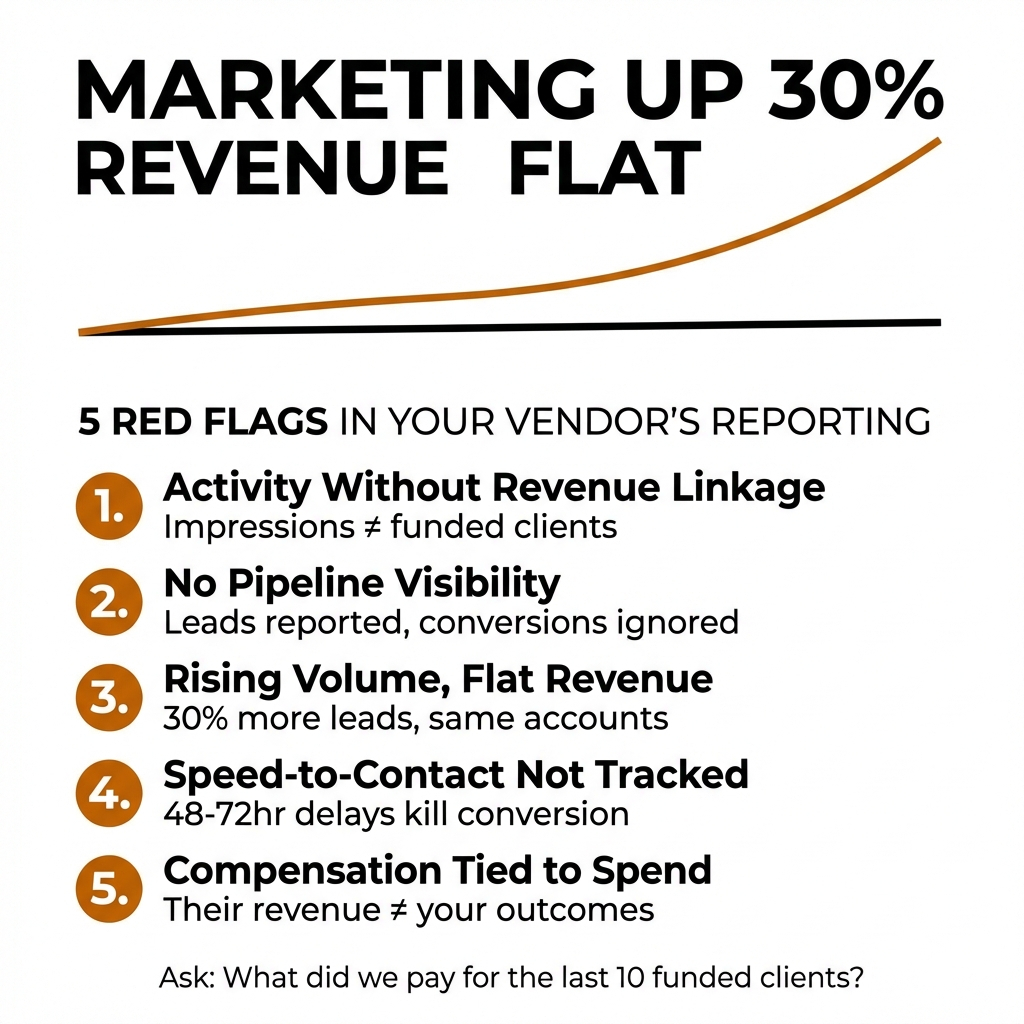
There are specific reporting patterns that immediately signal misalignment. If you see these in your vendor’s monthly dashboard, you are paying for activity, not revenue accountability.
First red flag: activity without revenue linkage.
If the report leads with impressions, clicks, reach, or engagement and does not clearly show cost per funded client, that is a problem. Activity metrics describe motion. Revenue-accountable metrics describe economic consequence.
Second red flag: no pipeline visibility.
If they report leads but cannot show consultation-to-close conversion rate, they are optimizing top-of-funnel volume, not economic outcomes. You need to see how many consultations were scheduled, how many were completed, and how many converted to funded accounts.
Third red flag: rising lead volume with flat revenue.
If lead counts are up 30 percent but funded accounts are flat, something is broken downstream. If the vendor is still celebrating volume, incentives are misaligned. Research from Email Tool Tester shows that GTM teams dealing with misalignment face a 48% higher rate of lost deals.
Fourth red flag: no discussion of speed-to-contact.
In advisory and specialty financial firms, delay kills conversion. If response time is not tracked, they are not thinking about revenue flow. Qualified inquiries that sit for 48 to 72 hours lose momentum. By the time contact happens, urgency has cooled or the prospect has spoken to someone else.
Fifth red flag: compensation tied to spend or lead count.
If their revenue increases when your ad spend increases, regardless of funded outcomes, their model is activity-driven. According to SFE Partners, only one-third of organizations successfully align their incentive programs with organizational goals.
The executive test is simple:
Ask your vendor, “What did we pay to acquire the last 10 funded clients?”
If they cannot answer clearly, they are optimizing for their business model, not yours.
Why Attribution Is Uniquely Difficult in 1031 Exchange and Self-Directed IRA Businesses
Tracking what actually drove a funded client is harder in specialty financial services for structural reasons, not technical ones.
First, the buying cycle is event-driven and irregular.
A 1031 exchange client does not wake up casually browsing options. They are triggered by a property sale timeline. The window is compressed, high-stakes, and often influenced by external advisors like CPAs or attorneys.
Second, trust layering is deeper.
A prospect might attend a webinar, download a guide, speak to a CPA, receive a referral, and only then contact the exchange provider. Which channel caused the funded client? The journey is multi-touch and relationship-driven.
Third, the decision risk is materially higher than most consumer purchases.
Moving tax-deferred proceeds or retirement assets creates hesitation. Prospects research quietly. They revisit the site multiple times. They forward content internally. Digital analytics often undercounts the true influence chain.
Fourth, funding does not always happen immediately after consultation.
There can be escrow timelines, custodial processing, and compliance reviews. That delay breaks simple attribution models.
In most industries, attribution is about tracking clicks to purchases.
In specialty financial services, attribution is about mapping trust accumulation to funded assets.
If you only measure last-click or lead source, you will misread where influence actually occurred. Revenue accountability in these firms requires tying marketing activity to funded accounts across time, advisors, and handoffs, not just digital touchpoints.
The Contract Structures That Realign Vendor Performance With Firm Revenue
If you want your marketing vendor to optimize for funded clients instead of lead volume, you need to change how they get paid.
Here are three contract structures that create alignment:
Structure 1: Base retainer plus performance bonus tied to funded accounts.
Pay a reduced base retainer for core services. Add a performance bonus based on cost per funded client targets. If cost per funded client stays below an agreed threshold, they earn the bonus. If it exceeds the threshold, they do not.
This structure keeps them focused on conversion economics, not just lead volume.
Structure 2: Tiered pricing based on consultation-to-close conversion rate.
If consultation-to-close rate improves quarter over quarter, their compensation increases. If it declines, their compensation decreases. This forces them to care about lead quality and pipeline flow, not just top-of-funnel volume.
Structure 3: Revenue share based on incremental funded accounts.
Establish a baseline of funded accounts per quarter. Pay the vendor a percentage of revenue from incremental funded accounts above that baseline. This ties their compensation directly to your revenue growth.
All three structures require clear tracking of consultation-to-funded conversion rate and cost per funded client. If your systems cannot track these metrics, the contract structure will not work.
Revenue accountability starts with measurement discipline.
The Accountability Framework That Makes Vendor Relationships Work
Contract structure alone will not fix misalignment. You need an accountability framework that defines ownership, measurement, and review cadence.
Here is the framework I use with advisory firms:
Define revenue-accountable metrics.
If a metric cannot be traced to funded revenue within a defined time window, it does not belong on the executive dashboard. Revenue-accountable metrics must answer one of three questions: How many funded clients did we acquire? What did we pay to acquire them? How long did it take to convert them?
Assign clear ownership at each pipeline stage.
Marketing owns qualified inquiry generation and speed-to-contact. Sales owns consultation scheduling and consultation-to-proposal conversion. Leadership owns proposal-to-funded conversion. No gray zones. No ambiguity.
Track daily and weekly metrics separately.
Daily, track number of qualified inquiries, speed-to-contact on new inquiries, number of consultations scheduled, and number of consultations completed. Weekly, track consultation-to-proposal rate, proposal-to-funded client rate, cost per qualified inquiry, and cost per funded client.
Run 30-day revenue accountability sprints.
Reduce measurement to a handful of revenue-linked metrics for 30 days. Review weekly in a structured 30-minute session with leadership. Look at what moved, where flow slowed, where handoffs failed, and where founder capacity is constraining growth.
By day 30, you know whether the system can convert demand or whether structure needs to change.
The Questions to Ask Before Renewing Your Marketing Vendor
Before you renew your marketing contract, ask these questions in a live conversation with your vendor:
“What did we pay to acquire the last 10 funded clients?”
“What is our current consultation-to-funded conversion rate, and how has it changed over the past six months?”
“What is our average speed-to-contact on qualified inquiries, and where are the delays occurring?”
“If we increased lead volume by 50 percent tomorrow, would our conversion rate stay the same, improve, or decline?”
“What structural constraint is currently limiting our ability to convert demand into funded accounts?”
If they cannot answer these questions clearly, they are not thinking about revenue accountability. They are thinking about activity justification.
That is the difference between a marketing vendor and a growth partner.
What Revenue Accountability Actually Looks Like
Revenue accountability means the system can convert demand without relying on founder bandwidth. It means you know exactly what you paid to acquire each funded client. It means your vendor is compensated based on economic outcomes, not activity volume.
Most advisory firms do not have this.
They have marketing dashboards that measure motion. They have vendors who optimize for what they get paid to deliver. They have pipeline breakdowns that no one is tracking.
The fix is not more reporting. It is clearer incentives, tighter measurement, and structural accountability.
If you want to know where your conversion is breaking down and how to realign your vendor relationships around funded client economics, I can help you map it in 30 days.
Contact me at fernando@rokture.com.